
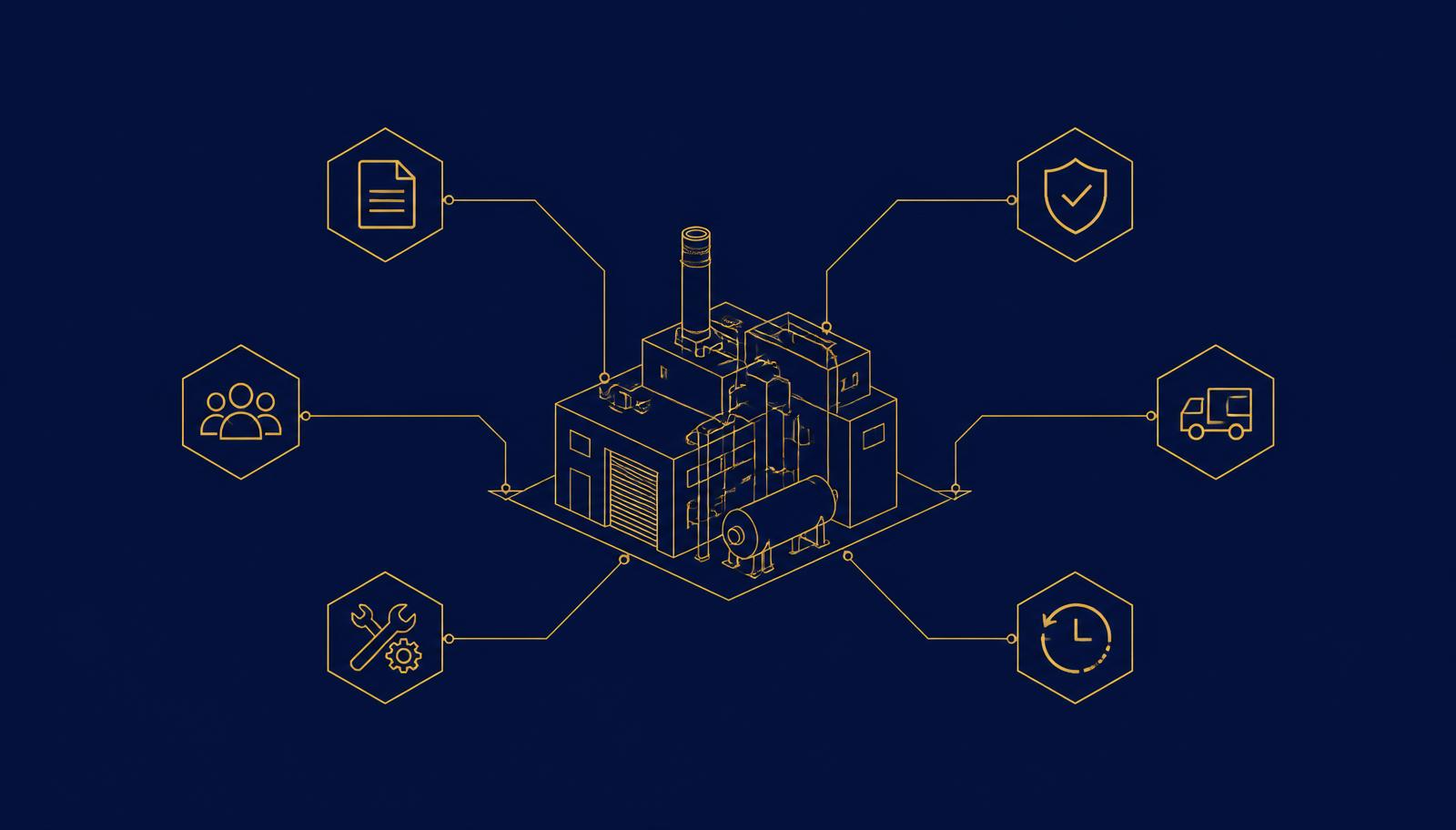
Assets don't exist in isolation.
A building isn't just a building.
A vehicle isn't just a vehicle.
A piece of equipment isn't just equipment.
Every physical asset sits at the centre of a network of information, responsibilities, relationships and history.
Who owns it. Where it is. Who is responsible for it. What condition it is in. When it was last maintained. Which documents belong to it. What compliance requirements apply. Which suppliers support it. What it has cost. What it is worth. What risks surround it. And, increasingly, what needs to happen next.
Yet the traditional approach to asset management has often reduced all of this to a line in an asset register.
Asset number. Description. Location. Owner. Status.
Useful? Absolutely.
Enough? No longer.
The traditional view of an asset is no longer sufficient
For decades, businesses have managed assets by recording them.
Create an asset register. Assign an identification number. Record its location. Track its value. Schedule maintenance. Store the relevant documents.
But the asset itself is rarely the problem.
The problem is everything that surrounds it.
A commercial vehicle, for example, may have:
- ownership and registration information
- insurance
- service history
- inspections
- compliance certificates
- mileage
- maintenance schedules
- repair records
- parts
- suppliers
- drivers
- operating costs
- warranties
- incidents
- photographs
- replacement considerations
These aren't separate pieces of information.
They are different parts of the same asset story.
When that information is scattered across spreadsheets, emails, folders, PDFs, maintenance systems and people's memories, the organisation doesn't really have a complete asset record.
It has fragments of one.
What is connected asset management?
Connected asset management is the practice of managing physical assets together with the people, places, documents, maintenance, compliance, costs, suppliers and history connected to them.
Instead of treating an asset as an isolated record, connected asset management treats the asset as the centre of an interconnected operational picture.
The difference can be represented simply:
Traditional asset management
Asset → record
Connected asset management
Asset → people → location → documents → condition → maintenance → compliance → suppliers → costs → history → risk → future decisions
- People
- Location
- Documents
- Condition
- Maintenance
- Compliance
- Suppliers
- Parts
- Costs
- History
- Risk
- Future decisions
The asset remains the centre.
Everything else provides context.
And that context is where much of the operational value lies.
Why connected asset data matters
Businesses rarely have a complete absence of asset information.
They have too much of it — stored in too many places.
An asset might exist simultaneously in:
- an ERP
- an Excel spreadsheet
- a maintenance system
- a shared drive
- an email inbox
- a compliance folder
- an insurance policy
- a supplier's records
- a technician's phone
- and someone's institutional memory
Each system may contain useful information.
But if those pieces aren't connected, people spend time reconstructing the asset's story whenever they need to make a decision.
That creates friction.
It also creates risk.
A missed inspection.
An expired certificate.
A forgotten warranty.
A duplicated maintenance task.
A part that wasn't ordered in time.
A supplier who no longer services the equipment.
A condition issue that wasn't properly documented.
A decision made without the full history.
Disconnected information turns simple asset management into detective work.
From asset registers to connected assets
A traditional asset register answers an important question:
What assets do we have?
Connected asset management goes further:
What do we need to know about each asset to manage it properly?
That distinction matters.
Knowing that a machine exists is useful.
Knowing that it is located in a particular facility, maintained by a particular supplier, has a recurring fault, requires a particular component, has a compliance certificate expiring next month, and has accumulated a significant maintenance cost is considerably more useful.
The asset hasn't changed.
Our understanding of it has.
Maintenance is part of the asset story
Maintenance is often treated as a separate operational function.
But maintenance is part of the asset's lifecycle.
A work order isn't just a task.
It is another chapter in the asset's history.
A repair isn't just an expense.
It tells you something about the asset's condition.
A recurring failure isn't just another job.
It may be a signal that the asset is becoming unreliable.
A replacement part isn't just inventory.
It is connected to the equipment that needs it.
Once those relationships are visible, maintenance data becomes much more valuable.
You move from simply maintaining assets to understanding asset behaviour.
That is the foundation for more proactive and predictive approaches to maintenance.
Compliance belongs to the asset too
The same applies to compliance.
Certificates, inspections, licences and statutory requirements are often managed as separate administrative obligations.
But they exist because of assets.
A certificate belongs to something.
An inspection relates to something.
A compliance requirement applies to something.
A responsible person needs to be accountable for something.
When compliance information is connected directly to the relevant assets, businesses gain a clearer picture of operational risk.
Instead of asking:
“Which certificates are expiring?”
you can ask:
“Which assets are approaching a compliance risk?”
That is a much more useful question.
Asset condition is part of the asset's history
An asset register tells you that an asset exists.
Its condition tells you how that asset is actually performing.
This is particularly important for buildings, properties, facilities, vehicles and equipment.
A property condition report, building condition assessment or equipment inspection shouldn't simply become a document that gets filed away.
It can become part of the asset's ongoing history.
Photos, observations, defects, inspections, repairs and subsequent condition assessments can build a picture over time.
That history can support better decisions about:
- maintenance
- repairs
- replacement
- insurance
- risk
- budgets
- capital expenditure
- and asset value
The condition of an asset is not just a snapshot. It is part of its story.
From asset data to asset intelligence
This is where artificial intelligence becomes particularly interesting.
AI is increasingly being applied to asset management, maintenance and operations. But AI does not create value simply because an organisation adds an AI assistant.
The quality and context of the underlying information matter.
If asset information is fragmented, incomplete or disconnected, AI has limited context.
If assets, documents, maintenance records, compliance information, people, suppliers, history and other relationships are connected, AI has something much more useful to work with.
It can begin to answer questions in context.
Not simply:
“When is the next maintenance task?”
But:
“Which critical assets have recurring maintenance issues?”
Or:
“Which assets have compliance requirements due in the next 30 days?”
Or:
“Show me assets that have had repeated repairs and may need replacement.”
Or:
“What do we know about this building's condition and maintenance history?”
This is the transition from asset data to asset intelligence.
And it changes the role of asset management from record keeping to decision support.
The future of asset management isn't more data. It's better-connected data.
Businesses don't necessarily need another place to store information.
They need information to make more sense.
The future of physical asset management will increasingly depend on connecting the different dimensions of an asset so that people can see the complete picture.
That means connecting:
Assets with their locations
Assets with their people and responsibilities
Assets with their documents
Assets with their maintenance
Assets with their compliance
Assets with their suppliers
Assets with their costs and value
Assets with their condition
Assets with their history
Assets with their future decisions
The result isn't simply a better asset register.
It is a more complete understanding of the asset itself.
What does connected asset management look like in practice?
A modern connected asset management approach should make it possible to move naturally between the things that are already related.
Start with an asset.
See where it is.
See who is responsible for it.
See its condition.
Open its documents.
Review its maintenance history.
Check its compliance status.
See its related work orders.
Check the parts required.
Review the suppliers involved.
Understand its costs.
Look at its history.
Then decide what needs to happen next.
The connections are what make the information useful.
Without those connections, businesses are left joining the dots manually.
With them, the dots become a picture.
Connected asset management is bigger than maintenance software
Connected asset management isn't simply the next version of a maintenance system.
It is a broader way of thinking about physical assets.
Maintenance is part of it.
Compliance is part of it.
Documents are part of it.
Condition is part of it.
Inventory is part of it.
People are part of it.
Suppliers are part of it.
Costs and value are part of it.
But none of those things are the asset on their own.
The asset is the centre.
The surrounding information provides the context required to manage it intelligently.
That distinction matters because physical assets increasingly represent significant operational, financial and strategic value.
Businesses need to know not only what they own, but how those assets are performing, what risks surround them, what they have cost, what they may require next and when a different decision should be made.
What is the future of asset management?
The future of asset management is moving beyond simply recording and tracking physical assets.
It is about creating a connected understanding of each asset throughout its lifecycle — from acquisition and installation through maintenance, compliance, condition, operation, repair, replacement and eventual retirement.
AI will increasingly help organisations interpret that information, identify patterns, surface risks and support decisions.
But the foundation remains the same:
You cannot build meaningful asset intelligence if the asset information is disconnected.
The future isn't about managing more information for the sake of it.
It is about connecting the information that already matters.
The asset hasn't changed. Our understanding of it has.
A building is still a building.
A vehicle is still a vehicle.
A machine is still a machine.
But the way we manage them is changing.
The traditional asset register gave businesses a list.
Modern asset management needs to give them context.
Connected asset management takes that one step further by bringing the asset and everything connected to it into one operational picture.
Because an asset is no longer just an asset.
It is the centre of a living network of information, responsibility, relationships, history and decisions.
Assets don't exist in isolation.
And the businesses that understand that will be better positioned to manage what they own, maintain what they depend on, reduce operational risk and make better decisions about what comes next.
The future of asset management isn't about managing more assets.
It's about understanding the assets you already have — and everything connected to them.
That is connected asset management.
Frequently Asked Questions
What is connected asset management?
Connected asset management is the practice of managing physical assets together with the people, locations, documents, maintenance, compliance, costs, suppliers, condition and history connected to those assets. It provides a more complete operational view than treating each asset as an isolated record.
How is connected asset management different from traditional asset management?
Traditional asset management often focuses on recording and tracking assets, including information such as asset ID, location, ownership and value. Connected asset management links that core asset information with the operational relationships and history surrounding the asset, creating a more complete view for decision-making.
What information should be connected to an asset?
Depending on the asset and organisation, connected asset information can include ownership, location, responsible people, documents, warranties, insurance, condition, maintenance, inspections, compliance certificates, work orders, parts, suppliers, costs, value, incidents, photographs and historical records.
What is the difference between asset management and asset tracking?
Asset tracking primarily focuses on knowing where assets are and maintaining basic information about them. Asset management is broader, covering an asset's lifecycle, maintenance, condition, costs, compliance, performance and eventual replacement or retirement. Connected asset management adds the relationships and context surrounding the asset.
How does connected asset management improve maintenance?
Connecting maintenance records to individual assets creates a continuous maintenance history. Organisations can see previous repairs, recurring faults, upcoming maintenance, related parts and suppliers, helping teams move from reactive maintenance toward more proactive and predictive maintenance.
How does AI fit into asset management?
AI can analyse connected asset information to identify patterns, highlight potential risks, answer operational questions and support decisions. The usefulness of AI depends heavily on the quality, completeness and context of the underlying asset data.
What is asset intelligence?
Asset intelligence is the ability to use connected asset data, historical information and analytics to understand asset condition, performance, risk and future requirements. AI can extend this capability by helping organisations interpret large volumes of connected asset information.
Why is connected asset data important?
Connected asset data reduces the need to manually piece together information from spreadsheets, documents, emails and separate systems. It provides a more complete view of each asset, helping organisations make better decisions about maintenance, compliance, risk, cost, performance and replacement.
About Axario
Axario is a connected asset management solution designed to bring the information surrounding physical assets into one connected operational view.
By connecting assets with their maintenance, documents, compliance, condition, people, suppliers, parts, history and other related information, Axario helps businesses move beyond simply recording what they own to understanding what they need to manage.
Because assets don't exist in isolation.
Explore connected asset management