
The maintenance happened. Can you prove it?
Why maintenance records, compliance evidence and a clear audit trail matter more than businesses may realise — and what insurers, auditors and regulators actually ask for.
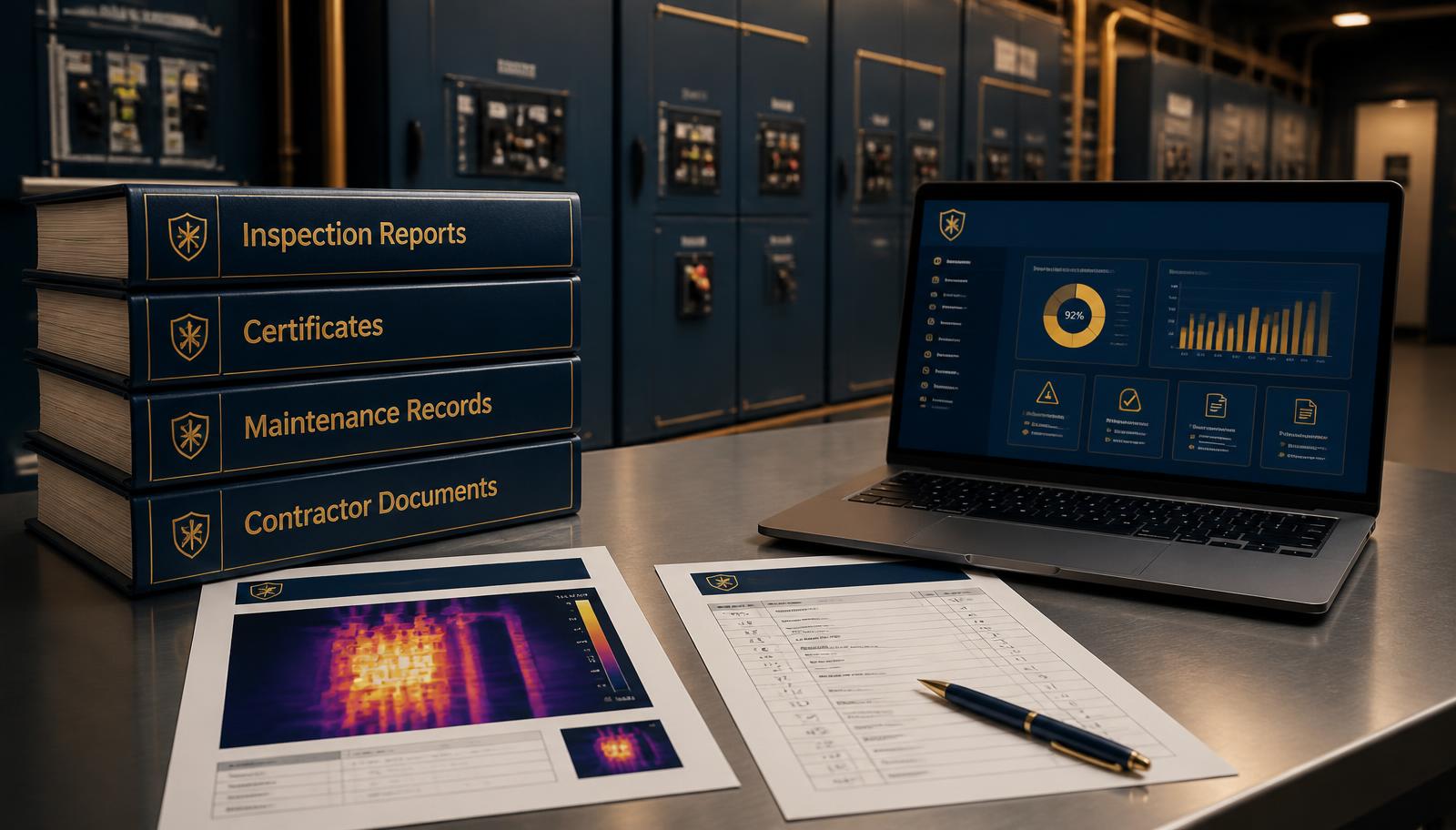
Why maintenance records, compliance evidence and a clear audit trail matter more than businesses may realise.
The building is insured.
The equipment is serviced.
The fire extinguishers were checked.
Someone did the electrical inspection.
And you're fairly certain the thermal scan was done last year.
But then something goes wrong.
A fire. An electrical failure. Equipment damage. A major insurance claim.
Suddenly, knowing that the work was done may not be enough.
Can you prove it?
When was the equipment last serviced? Who completed the work? What did they find? Were any faults identified? Were those faults repaired? Is there a report? An invoice? A certificate? A photograph? And when was the next inspection supposed to happen?
For many businesses, answering those questions means searching through emails, spreadsheets, shared drives, filing cabinets, contractor records and WhatsApp messages.
And at the point where something has already gone wrong, that can become a much bigger problem.
Insurance doesn't replace maintenance
Businesses insure their buildings, equipment and operations to protect themselves when the unexpected happens.
But insurance doesn't remove the responsibility to properly manage and maintain those assets.
In March 2026, PSG Insure highlighted lack of maintenance, wear and tear and failure to exercise appropriate duty of care among the common mistakes that can lead to insurance claims being reduced or rejected.
For businesses, PSG specifically notes that this can extend to requirements such as fire-safety measures, security protocols and equipment servicing.
It also points out that, at claims stage, policyholders may be required to provide supporting documentation such as proof of ownership, invoices, valuations and maintenance records.
Incomplete or inaccurate information can contribute to disputes, delays or reduced settlements.
Maintenance-related insurance disputes are not unusual
The National Financial Ombud Scheme South Africa's 2024 Annual Report provides an interesting view of the problem.
Commercial insurance complaints represented 14% of all non-life insurance complaints finalised during 2024.
Among commercial insurance disputes, the primary reason for complaints was claims rejected because of exclusions in the policy — particularly exclusions relating to gradual deterioration, lack of maintenance or wear and tear.
Complaints involving gradual deterioration, lack of maintenance or wear and tear increased by approximately 6% compared with 2023.
This doesn't mean every one of those claims would have been successful if better records had existed.
But it highlights something important.
Maintenance is not only an operational issue. It can become an insurance issue too.
Sometimes the requirement is very specific
Consider something as seemingly routine as an electrical thermal scan.
Infrared thermography can be used to identify abnormal heat in electrical equipment and components before it develops into a more serious problem.
Electrical faults have historically been linked to close to one in ten reported fires in South Africa, with industrial fire losses running into the hundreds of millions of rand in some years — and electrical distribution boards are consistently named among the most common ignition points in commercial fire investigations. It's a risk that sits quietly until it doesn't.
Depending on the business and its insurance policy, these inspections may also form part of specific insurance requirements.
For example, Safire Insurance's commercial policy wording includes an infrared thermography warranty where specified in the policy schedule.
It requires an infrared thermography analysis at least once during each 12-month period on electrical distribution boards and certain machinery.
If potential ignition points or other safety risks are identified, remedial or preventative maintenance must be completed without undue delay.
A further thermography analysis must then be conducted to confirm that the hazards have been addressed.
Think about the information trail that creates.
Inspection → finding → corrective action → contractor → completion → follow-up inspection → evidence.
Now multiply that across an entire business.
It's rarely just one inspection
Depending on the organisation, its assets, premises, industry and insurance requirements, there may be many different inspections, services, certificates and recurring tasks to manage.
- Electrical inspections
- Thermal scans
- Fire equipment servicing
- Certificates of Compliance
- Generators
- HVAC systems
- Lifts and lifting equipment
- Security and alarm systems
- Machinery servicing
- Emergency equipment
- Contractor certifications
- Insurance risk requirements
- Preventative maintenance schedules
The challenge isn't necessarily that businesses don't do these things.
The challenge is keeping track of all of them, connecting them to the right assets or locations, acting on what is found and retaining the evidence afterwards.
Because completing a compliance task and being able to demonstrate that it was completed are two different things.
The work may have happened. The evidence may be somewhere else.
This is where the operational gap starts to appear.
A contractor emails the thermal scan report to the facilities manager.
An invoice goes to finance.
A fault is reported over WhatsApp.
Someone adds the repair to a spreadsheet.
The technician completes the work.
A photograph sits on someone's phone.
The certificate is saved to a shared drive.
And the next inspection date is added to someone's calendar.
Individually, all of those processes may work.
Collectively, however, they don't necessarily create a clear operational history.
Six months later, the facilities manager leaves.
A year later, a different contractor is appointed.
Two years later, something goes wrong.
Now someone needs to reconstruct the story.
An asset is no longer just an asset
Managing physical assets today means managing far more than a list of equipment.
Every important asset can have a history.
- Its purchase information
- Its location
- Its value
- Its warranty
- Its maintenance
- Its inspections
- Its faults
- Its parts
- Its contractors
- Its compliance requirements
- Its documents
- Its costs
And the evidence of what has happened to it over time.
The more fragmented that information becomes, the harder it becomes to see risk before something goes wrong.
A spreadsheet can tell you when something is due. That's only part of the story.
A maintenance schedule is important.
But knowing that an inspection was due on 15 August isn't the same as knowing what happened next.
Was it completed?
Who completed it?
What did they find?
Did the inspection identify a risk?
Was corrective work required?
Was a work order created?
Was the repair completed?
Is there evidence?
Was a follow-up inspection required?
When is the next one due?
This is where maintenance management, compliance management and audit readiness begin to overlap.
The real value isn't simply recording a date.
It's maintaining the chain of events around the asset.
What would happen if someone asked you tomorrow?
Imagine an insurer, auditor, client, landlord or regulator asked for the complete maintenance and compliance history of one of your critical assets.
Could you produce it?
Not eventually.
Not after asking three departments and two contractors.
Could you see it clearly?
- The asset
- The requirement
- The inspection
- The finding
- The work performed
- The person or contractor responsible
- The documentation
- The evidence
- The next action
That is a very different level of operational visibility.
From remembering compliance to managing it
Businesses are becoming increasingly complex.
More assets. More contractors. More locations. More systems. More compliance requirements. More information.
Trying to remember what needs to happen — or relying on disconnected systems and people to keep everything together — becomes increasingly difficult as an organisation grows.
The alternative is to create a connected operational record.
One where an asset doesn't sit separately from its maintenance.
Maintenance doesn't sit separately from compliance.
Compliance doesn't sit separately from documentation.
And documentation doesn't have to be reconstructed when something goes wrong.
That is the thinking behind Axario Business.
Axario Business brings assets, preventative maintenance, work orders, contractors, compliance information, documents and operational history together so businesses can build a clearer record of what needs to happen, what has happened and what needs attention next.
Because good maintenance isn't only about doing the work.
It's about knowing it was done — and being able to prove it.
Know your risk. Control your assets. Prove your compliance. Start a free trial or get in touch.
Sources
- National Financial Ombud Scheme South Africa (NFO), NFO Annual Report 2024 — commercial insurance complaints represented 14% of non-life complaints finalised in 2024; policy exclusions relating to gradual deterioration, lack of maintenance and wear and tear were the primary reason for commercial insurance complaints, up ~6% compared with 2023.
- PSG Insure, Simple mistakes that lead to rejected insurance claims — and how to avoid them, 18 March 2026.
- Safire Insurance, Commercial Policy — Infrared Thermography Warranty.
- Fire Protection Association of Southern Africa (FPASA) historical fire statistics — electrical faults as a share of reported fires and associated industrial losses.
Insurance requirements differ by insurer, policy and risk. Businesses should review their own policy wording and requirements with their insurer or broker.