
Four Things You Should Know About Your Assets, Rather Than Try to Remember
Where is it, when is it due, what's its history, is it compliant? Why asset knowledge that lives in people's heads, WhatsApp threads and stale spreadsheets isn't a system — and what to build instead.
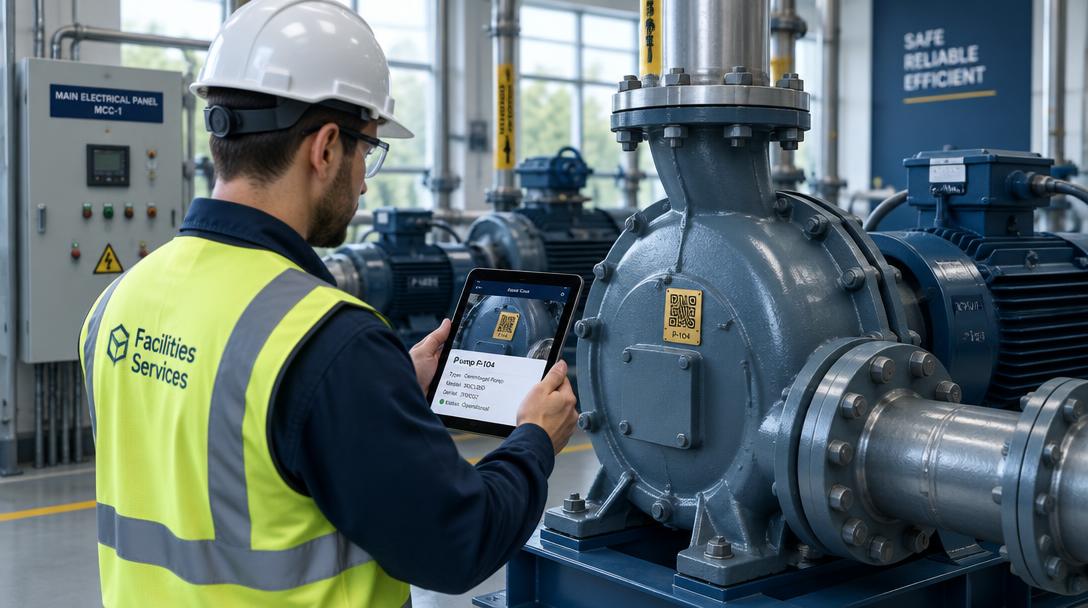
Walk onto almost any facility floor and ask three different people the same question — where's the backup generator, when did the fire panel last get serviced, is that HVAC unit still under warranty — and you'll often get responses that vary between a blank stare, a guess or an 'I don't know' answer. Not because anyone's careless. Because the real answer is sitting in someone's head, or in a WhatsApp thread from four months ago, or in a spreadsheet that stopped being updated when the person who owned it changed jobs.
Most facilities and operations teams don't have a data problem so much as a memory problem. And memory, no matter how experienced the person, isn't a system.
What people are actually trying to remember
Strip away the jargon around asset registers and compliance tracking, and it comes down to four questions that get asked, informally, dozens of times a day across any site:
Where is it, and what is it? Not in theory — right now, physically, which pump or panel or unit is this. The gap between "what the paperwork says" and "what's actually bolted to the wall" is where most confusion starts. A tag that's peeled off, a component that's been swapped without anyone updating the record, an asset moved to another building eighteen months ago and never logged — each one turns a two-minute job into a twenty-minute hunt – and that's best case scenario, before any work has even been done.
When is it due for attention? Preventive maintenance only works if someone reliably knows a service is coming before it's overdue. The moment that knowledge lives in one technician's memory rather than a schedule, it survives exactly as long as that technician stays in the role, pays attention that week, and doesn't have six other things competing for their recall.
What's happened to it before? A single unexplained failure tells you very little. A pattern tells you a lot — but only if the history is actually attached to the right asset. The moment maintenance history gets logged against the wrong record, even once, every conclusion built on that history afterward is compromised, and usually nobody notices until a wrong decision comes into play.
Is it still compliant? In South African facilities and operations environments, this carries real weight — electrical, fire, OHS, and building compliance all run on statutory clocks that don't pause because someone was busy or the person that knew everything changed roles. "I think it's up to date" is not an answer anyone wants to give an inspector, an insurer, or a client after an incident.
Why these keep slipping through the cracks
Typically, none of this happens because someone's bad at their job. It happens because the default way most operations run — tribal knowledge, spreadsheets, someone's memory of "how we've always done it" — puts the burden of remembering on individual people, and people are genuinely not built to hold hundreds of moving details in their heads indefinitely. It's not a discipline failure. It's a design failure. You're asking a human to do the job of a system.
The fix isn't "try harder to remember." It's removing the need to.
Building processes within a system that remembers so people don't have to
The teams that keep their asset data trustworthy over years, not just for the first few months after a cleanup, tend to share one habit: they have a process and it sits within a system — not any one person — responsible for holding the answer to those four questions.
That shows up in a few concrete ways:
- Identification that survives contact with reality. A QR code or tag that a technician can scan on the floor and land directly on the correct record beats any spreadsheet lookup, because it removes the "which one is this again" guesswork entirely. The tag has to actually survive the environment it's in, too — heat, washdowns, UV — or it becomes one more thing nobody trusts within a year.
- Updates that happen as a side effect of the work, not a separate task. If updating the asset record requires someone to remember to go do it afterward, more often than not it won't get done — not because people don't care, but because "remember to update the system later" competes with everything else on their plate. The update needs to happen during the job, or on the go, as part of doing the job, not bolted on as extra admin.
- Schedules that push information out, rather than waiting to be asked. A preventive maintenance date that sits quietly in a table until someone thinks to check it isn't much better than no schedule at all. The value comes from the system surfacing what's due, to the right person, before it becomes urgent — so nobody's relying on remembering to look.
- One clear owner for the whole picture. Even a well-designed system needs someone accountable for whether it's actually being used correctly across sites and teams — not to personally remember every detail, but to notice when the system and reality have started drifting apart.
Platforms like Axario Business are built around exactly this shift — treating the asset register, maintenance history, and compliance status as something the system actively tracks and surfaces, rather than something staff are expected to carry in their heads and re-enter from memory when someone finally asks. Scan a code and the correct record comes up, rather than being reconstructed from a legacy tag and a guess. A service schedule generates its own due work automatically, rather than depending on someone checking a calendar. It's a fairly unglamorous shift in practice — but it's the difference between a register that's accurate on the day it was built and one that's still accurate two years later.
The goal isn't a perfect register. It's one nobody has to hold in the back of their minds.
No facility will ever have flawless data, and chasing perfection is usually a waste of time. What's worth chasing is something more modest and more durable: a system where the answer to "where is it, when's it due, what's its history, is it compliant" doesn't depend on catching the right person on the right day.
That's not a bigger ask than what most teams already do. It's actually a smaller one — it needs to be maintained and then it just needs to be asked of a system instead of a person.
If you're curious what that looks like in practice for facilities and operations teams, Axario Business is one place to see it in action.